Champagne Breakfast
A new life in Washington D.C.

The Beginning of the End. Laguna Beach, 2017
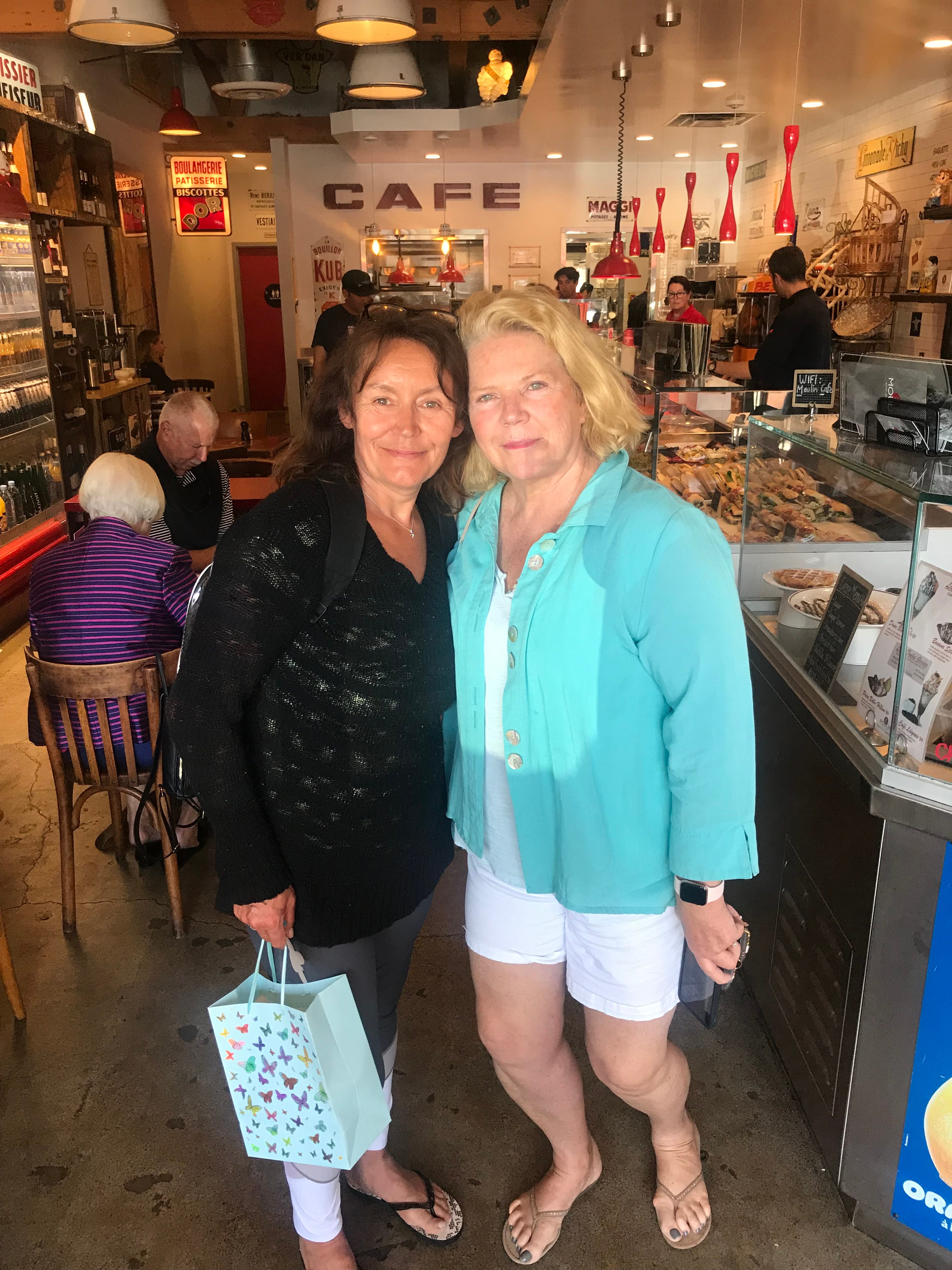
We don’t bother to hurry. Moulins in Laguna Beach is French-owned and more likely to be late in opening than any other breakfast place in the Southern California seaside town that wakes with the birds and the jaunty joggers dodging the homeless squatting on million-dollar views of the Pacific Ocean.
Right on time at (ten past) 9 am, the double doors ease open, and the staff, with smiles but never apologies, announce that Moulins is open for business. We are met first with the smell of croissants fresh out of the oven, warm chocolate just released into the pastry, almond burnt not to a crisp but just crisp, and the soft, buttery defeat of an Ottoman crescent.
They sit by the cash till, begging to be bought, but first you must battle through the wild meadow of cakes and salads behind glass cases demanding attention as you wait to be served in the long, slow line. It is the only place in California I know where patience is rewarded.
We head not to the food, still untouched by the gannets who will pick and ravage through the day, but for the fridge packed with orange juice, energy drinks, sodas, and $5 waters that will soon be snapped up by hungry runners to wash down their pastry excuses. I reach for a half bottle of Laurent-Perrier champagne.
My wife, Michelle, leaves me to take care of the order while she snags a table on the patio. After a morning on the beach, we often roll in here in sandy swimsuits, damp sweats, and tangled hair. The crepes are a favorite with the kids, and the servers are happy to step over our Siberian Husky, who is playing dead at the entrance. But today, Michelle is dressed to impress; a silky red dress falls easily off her shoulders, gathering slightly at the waist before landing just above her white espadrilles, the ties sidling out of sight along her tanned calves. Her hair is straightened and long, and the slight blush on her cheeks matches her lips and sets off the knife lines of her cheekbones. She wouldn’t have been out of place at Guy Savoy in Paris. I wash up well, too, in jeans and a crisp, white shirt, if only to complement my beautiful wife, who no longer has to wash Nutella off little, salty faces or wipe dribble from her dress.
There is no judgment from the young French waitress, the owner’s niece from the Dordogne, who is spending the summer improving her English. She simply asks if I would like an ice bucket and says she will bring the champagne to our table. I am grateful she doesn’t offer to send over a cupcake with a candle or round up the servers to sing ‘Joyeux Anniversaire.’
I order a quiche Lorraine and a croque monsieur with a side of French fries, and, because I am thinking about how much I don’t want the awkwardness of a celebratory cupcake, I add a molten dark chocolate hazelnut tart for dessert. The waitress—her name is Fabienne—asks for my table number and is already serving the next customer as I count my change.
It is a gorgeous morning, as they invariably are in Orange County. I always joke about how much people talk about the weather in England, forgetting how rich and varied (and wet) it is. In California, you don’t hear folks forecasting the week; it’s usually a done deal. They prefer to say they’ve been blessed, as if the unrelenting sunshine is their divine right.
With the tourists gone and the autumnal sun taking a more benevolent hue, the September street outside Moulins is still quiet with a handful of scraggy, blond surfers, their futures wrapped up in the tides, ambling past with boards under their arms to check on the waves breaking next to Pacific Coast Highway, a short walk away.
Professional types in Teslas and Oakleys, bobs and side partings, park outside to eat on the run. The regulars remember to put money in the meters, knowing they will have to wait. The others must factor in the cost of a parking ticket when calculating the price of their coffees. We watch them knowingly, nodding occasionally to other locals.
The champagne arrives first, as it should. It opens with a loud pop, and our neighbors smile, silently questioning why we would be drinking at 9.30 am on a Thursday. We smile back.
We take our first sips of champagne, the bubbles flooding our dry, tight mouths with life, and a voice calls out our names from across the road: “My English friends! Where’s the party?”
Michael Minutoli is the Laguna Beach Town Greeter. It’s an honorary job he has given himself, but the tradition dates back more than 125 years, and the town’s most famous greeter, Eiler Larsen, a shaggy-haired Danish immigrant who welcomed visitors from the 1940s to the early 1970s, has two statues in his memory. Every morning at 7 am, Michael arrives at the corner of Broadway and PCH to dance and wave a greeting to passing motorists. Every afternoon, he dances outside the Sapphire restaurant up the hill at the other end of Laguna. His props are an empty plastic bottle, crushed flat so he can step on it and spin, and a small assortment of extravagant hats and outfits.
Today, he is wearing an old favorite, a red military uniform with yellow tassels and a white sailor’s cap with matching gloves. In another life, he would crash Hollywood parties and be photographed with the likes of Tom Hanks, Elton John, and Michael Jackson. In another life before that, he was married in Boston with a wife and two sons. Now he is homeless and sleeps on the beach. He says he enjoys making other people happy, but he takes the unpaid job very seriously. He knows every local and remembers every name. He survives, not by panhandling, which he deems below the status of a town greeter, but through handouts from restaurant and shop owners. It’s a small price to pay for the smiles.
Dig a little deeper, and it isn’t so easy. Michael has only recently been reconciled with his now-grown children, who never understood why their father left them to bring fleeting joy to strangers. An old iPod full of music I gave him was stolen the first night from his sleeping spot on the beach, and his very occasional meltdowns are a clue to a much deeper issue.
He dances across the street, carrying a plastic bag containing all his belongings. “Congratulations! Every day is champagne day in Laguna Beach.” He doesn’t ask what we are celebrating. “I just saw your daughter in Laguna Coffee. Such a lovely girl, takes after her mother.”
He takes an impossibly smooth pebble from his jacket pocket and gives it to Michelle “for luck.” She smiles, touched to tears, but I can see she doesn’t want to chat.
“What are you listening to?” I ask. Michael always has his earphones in.
“Some Stones,” he says, adopting a gunslinger pose. “I’m working on my Jagger moves.”
He waves across the restaurant. “How ya doin’, Debbie? Have a terrific day.”
“Gotta get back to work,” he says, turning back to us and then strutting away like a catwalk model. “Moves like Jagger,” he sings over his shoulder.
The food is coming, and I notice Michelle’s glass is empty. I take advantage of a rare lull and run to the cashier with another half-bottle. By the time I’m back, the table is full with breakfast, fries, and chocolate, and I commandeer a spare chair for the champagne bucket refreshed with new ice and more bubbles. I raise a toast, and we share a look. “To the future,” I say.
We both go to say something, but the look seems to have said it all. We dig into our breakfasts, listening to the door opening and closing behind us.
The croque and the quiche are delicious, but we don’t manage the chocolate-hazelnut tart. We decide to leave after the owner arrives from one of his other patisseries, sees us, and the two upturned champagne bottles.
“I love you guys,” he says. “You know how to live like the French. If you want champagne in the morning, you drink it. Why wait until lunchtime? This must be the third time this week.”
He pats my shoulder, kisses Michelle on the cheek, and goes inside. She carefully wraps the uneaten tart in a napkin, gathers up her coat, and waits for me to finish my champagne.
It is, indeed, the third time this week. The third champagne breakfast, the third visit to the hospital, and the third time we have stopped the whirlwind long enough to breathe.
In the first hospital visit, the cancer nurses trialed a new biopsy needle on my wife and kept jabbing at the lump in her breast until she cried out for them to please stop. I wasn’t allowed in with her, and my heart broke the moment she walked into the waiting room, her pale, elfin face filled with pain.
We went to Moulins that morning and ordered champagne. Then we called the children to tell them the worst.
On the second visit, we saw the surgeon together. He was young and all-American, and his name was Washington. The tumor was the size of a Lacrosse ball (slightly smaller than a tennis ball), he said, and he had scheduled an operation to remove it the following week. There would be chemo and radiation and drugs, and it was all arranged. He was certain. He didn’t entertain any doubts. Or questions.
We went straight to Moulins and ordered champagne. That was a full bottle.
The third hospital visit was just as devastating. The cosmetic surgeon was a woman, and she, too, was certain. It would have to be a mastectomy. The tumor was simply too large for anything else, and it would be at least a year before she could start any reconstruction. She dropped these bombs while checking her Instagram, texting, and taking calls. She had the bedside manner of a serial killer.
And so here we are again, drinking champagne as our world collapses around us. We raise a glass to the French poet, Paul Claudel, who wrote: “In the little moment that remains to us between the crisis and the catastrophe, we may as well drink a glass of champagne.” And my movie buff wife quotes Bette Davis, who, as Kit Marlowe in ‘Old Acquaintance,’ said: “There comes a time in every woman’s life when the only thing that helps is a glass of champagne.” We’d laughed over these sayings before, but neither of us is laughing now.
This moment is all we can be sure of, the first sip of champagne, and with it the memories of all the celebrations from times past. The courting, the passion, the contentment, the wedding, the births, the birthdays, the Christmases, the bright summer evenings overlooking a darkening ocean with a fleet of pelicans in a V-shaped shadow across the red sky, and a glass of champagne to celebrate absolutely nothing other than life together, uncomplicated and forever.
We have little faith in the doctors and their cutting, and their poison and their certainties. We don’t believe in their prognosis, or in the future they are planning for us that can so easily be erased. But we do have now, the next minute, and the next.
We will not keep our champagne on ice.
My wife sits back down, takes the chocolate-hazelnut tart out of her bag, carefully unwraps it, and places it back on the plate. There’s that look again, the one that says in an instant everything that has passed between us in 30 years of marriage.
And I head inside to buy another bottle of Laurent-Perrier, knowing for certain that tomorrow can wait a little longer.